Each European country left a different mark on old furniture
Most pieces in the Martello collection come directly from Europe — Italy, France, Germany, Austria — and each region has its own stylistic language, shaped over centuries of local craft tradition. You don't need to be an art historian to recognise the differences and, more importantly, to combine them correctly in a single home. The basic rule: pieces of different origin combine well when they share something — the same wood species, a similar colour palette or a comparable historical period — not when they're thrown together just because "they're all old".
Italian style: curves, carving and discreet gold
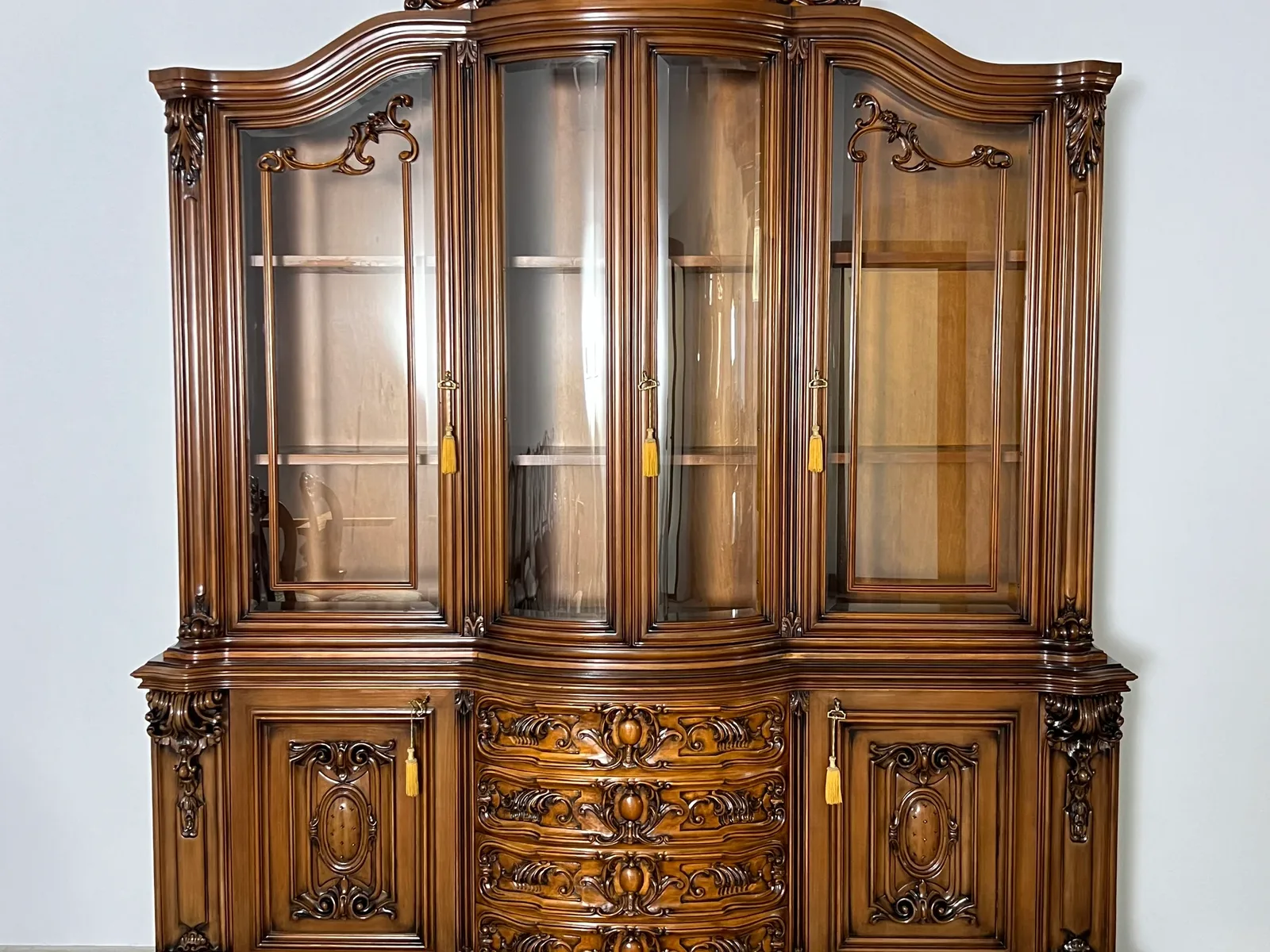
Old Italian furniture, especially from the Venice and Tuscany regions, is recognised by generous curves, turned legs and visible carving — display cabinets, consoles and chairs with hand-worked details, often finished with a discreet gold leaf on the edges or ornaments. It's the most "theatrical" of the three styles, suited as a room's centrepiece, not as background. An Italian display cabinet works best on its own, leaving the rest of the room's furniture simpler — exactly the rule we also explained in the guide to choosing a vintage display cabinet.
French style: quiet elegance and fine lines
Old French furniture — nightstands, mirrored consoles, chests of drawers — favours finer lines than Italian pieces, with slender, gently curved legs and bronze or brass hardware, often in delicate floral shapes. It's the easiest of the three to live with in a modern home, precisely because of its restraint — a French nightstand fits as naturally into a minimalist bedroom as into one full of vintage pieces. Here, what matters less is where the piece sits and more what you pair it with: next to a hefty Italian armchair, the French silhouette looks almost fragile; next to simple modern furniture, the same piece becomes the room's point of refinement.
German style: solidity, geometry, visible durability
Old German furniture puts weight on structure and proportion more than ornament — straighter lines, geometric panels, a visible solidity even in smaller pieces. A desk or bookcase in the German tradition works excellently as an anchor in a room where the other pieces are more decorative — Italian or French — offering a visual counterpoint that avoids the feeling of "too much ornament". The classic combination, also used by experienced interior designers: a solid German piece as the functional base (desk, bookcase, table), completed with French accents (mirror, nightstand) and a single, more theatrical Italian moment (a cabinet, a chandelier).
How to choose a starting point for your own home
The safest way to combine all three styles without it feeling like a random mix is to pick a single "anchor" piece — the one you're already drawn to — and build the rest of the room around it, not the other way round. For further inspiration on blending old styles with a contemporary interior, the guide to combining vintage and modern furniture rounds out exactly this subject. Because every piece in the Martello collection has a verified provenance, the team can confirm a specific piece's origin directly and help you choose combinations that work — most easily through a conversation on the contact page or a visit to the showroom in Nimoreni, Ialoveni, where pieces from all three traditions often stand side by side.