Victorian Style Furniture: How to Recognize It
The name comes from Queen Victoria of Great Britain (1837-1901), but Victorian style isn't one single look — it's an umbrella covering several historical revivals: Rococo, Gothic, Renaissance, all reinterpreted by the era's craftsmen with more carving, more upholstery, and more symmetry than the originals. It's furniture you recognize at a glance, yet find hard to explain. Here's exactly what to look for.
Rich carving, no empty surfaces
The first rule of Victorian furniture: no smooth surface stays smooth for long. Legs, backs, and tabletop edges are carved with acanthus leaves, floral garlands, or scrollwork, often in deep, hand-worked relief. Compared to the more restrained elegance of Louis XV style, Victorian ornament is denser and more "layered" — a good piece has no decorative gaps.
Cabriole legs and a curved silhouette
The cabriole leg — curving outward at the knee and inward at the ankle, often ending in a claw or a scroll — is the visual signature of Victorian-inspired furniture. You'll find it on chairs, tables, and consoles alike. Unlike the straight lines of Empire furniture, covered in our guide to Baroque and Empire, the Victorian silhouette is always curved, never rigid.
Upholstery: velvet, tapestry, and floral patterns
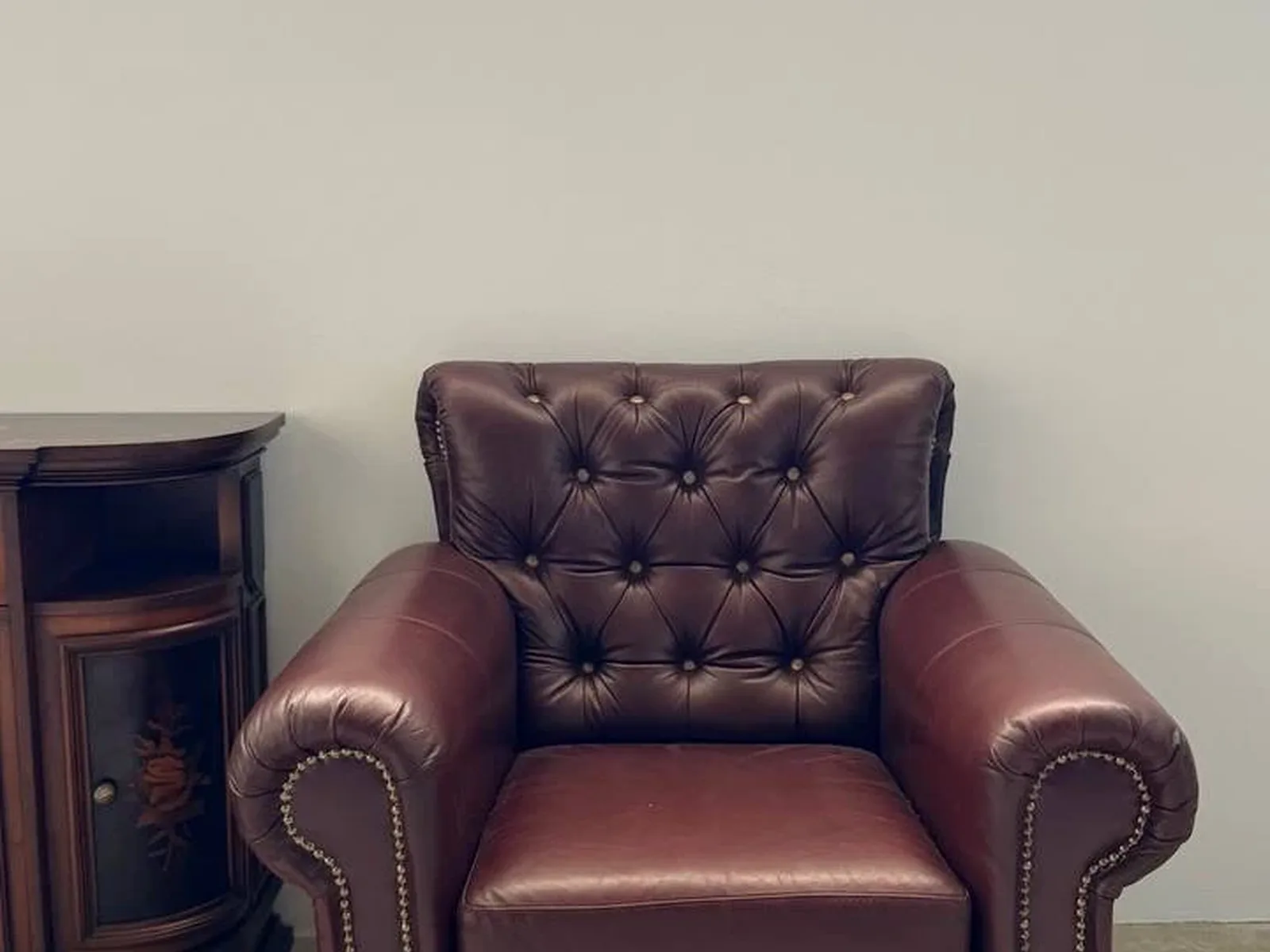
Victorian chairs and armchairs almost always used rich textiles — velvet, damask, or tapestry with large floral motifs. Button tufting, popularized by Chesterfield sofas, also dates from this era. A genuine piece has hand-worked upholstery with a continuous pattern across corners, not just decoratively applied on one face.
Vitrines and sideboards: dark wood, glass doors
In the dining room, Victorian style shows most clearly in massive vitrines and sideboards in dark walnut or mahogany, with bowed glass doors and interior shelves for porcelain. The top cornice is almost always ornamented, and the legs visually carry the whole piece's weight without looking fragile.
How we choose at Martello, in Moldova and Romania
Every piece in the Martello catalogue is personally checked by us for the authenticity of the carving and the wood, not just its overall look. You can see and touch them at our showroom in Nimoreni, Ialoveni, fifteen minutes from Chișinău, or browse the vintage furniture section. Once you know what to look for — the carving, the leg's curve, the upholstery — a genuine Victorian armchair becomes easy to tell apart from a modern imitation.