The Hand-Painted Chest: A Work of Art That Holds Your Coats
Some furniture simply serves; some furniture speaks. A hand-painted chest of drawers does both: it tucks gloves, keys and scarves out of sight, yet the eye lands first on the top — on the flowers, on delicate scenes in colours that look painted yesterday, though the pigments have lived through decades. Placed in the entryway, it becomes the first thing a guest sees, and the first thing to say that someone with taste lives here.
A tradition born in Venetian workshops
Painted furniture is no recent fashion. Its roots reach into seventeenth- and eighteenth-century Venice, where workshops coated chests, secretaires and vitrines in coloured lacquer and floral scenes, imitating the costly Oriental lacquers arriving from the Far East. In parallel, European salons embraced chinoiserie — the Western fantasy of Asia, with exotic birds, pagodas and peony branches. Each piece was decorated by an artist's hand, which is why no two are ever alike. Tellingly, in 2026 designers are pulling exactly these accents back into the spotlight: ginger jars, chinoiserie motifs and embroidery are returning to top interiors — a sign that the taste for painting on wood is anything but dated.
How to recognise genuine painting
A truly hand-painted chest reveals itself in the details. Look at the edges of the motifs: a brush leaves faint variations, strokes that don't repeat mechanically, the fine tremor of a human hand that industrial transfer can never fake. Study the layers of lacquer — good pieces have depth, the colour seems to float beneath a polished film rather than sit flat on the surface. Pull out a drawer: solid wood, dovetail joints and the uneven patina inside tell the story of a piece that has been lived with. A printed foil decor is perfectly uniform, cold, without soul. The difference between a one-of-a-kind piece and a mass-produced one is worth understanding before any purchase — we wrote at length about why the difference between a unique piece and series furniture matters.
Why the entryway is its stage
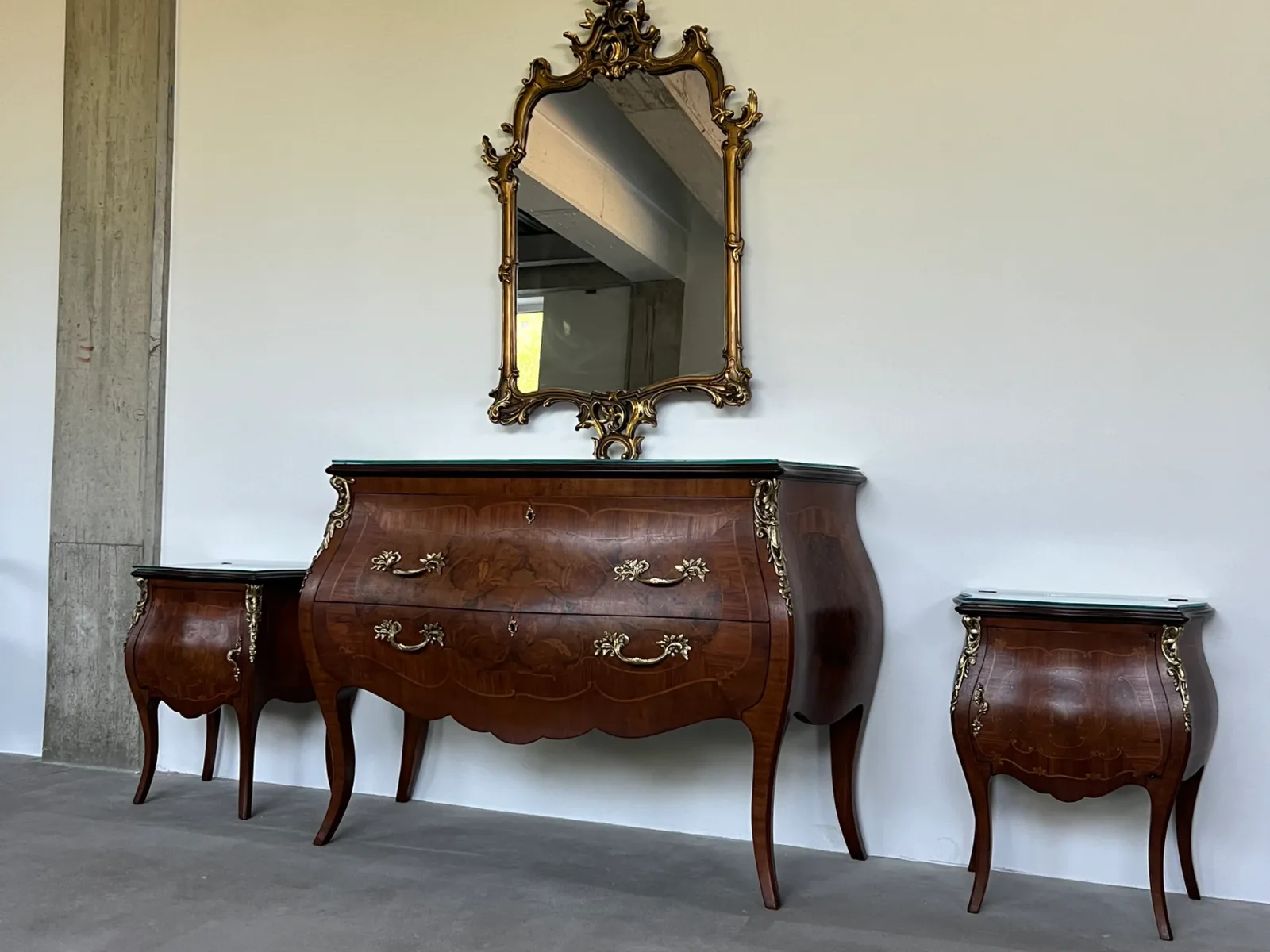
The hallway is the most neglected space in a home: narrow, transitional, often left bare. That is precisely why a painted chest makes its strongest impression here. Against a neutral wall, its colour and motif become a functional painting. It sits at the right height for a mirror above it, a warm lamp and a vase of flowers, turning the entrance into a composed corner rather than a corridor. If you prefer a fuller silhouette, the curve of a bombé chest for the hallway adds extra grace; if you want versatility, a vintage chest that moves between hall and bedroom travels beautifully from one room to another.
How to show it at its best
A painted piece wants quiet around it. The golden rule: it speaks, everything else listens. Choose a wall in a neutral tone — warm white, greige, muted sage — to let the painting's colours breathe. Echo a single shade from the decor in one other element in the hall: a cushion on a bench, a picture frame, a lampshade. Don't crowd the top: a mirror, a light source, one or two carefully chosen objects. To pair the complementary pieces of an entrance correctly, our guide to the hallway coat stand helps you compose a unified ensemble, while a mirror with a solid-wood frame above it doubles the light and ennobles the corner.
How to care for it so it lasts generations
Genuine painting is delicate but long-lived when treated correctly. Dust it with a soft microfibre cloth, dry or barely damp, following the grain of the wood; never abrasive products, bleach or solvents, which eat away pigment and lacquer. For the fine details between motifs, a soft brush lifts dust from the grooves without rubbing the painted layer. Keep the piece away from direct sunlight, which fades colours over time, and away from radiators that dry out the wood. Test any new product on a hidden area and wait a day. The room's humidity matters just as much: air that's too dry cracks the wood, while air that's too humid lifts the varnish, so a balanced room extends the life of the painting more than any care product ever could. For the full routine of pieces with history, return to our guide on caring for vintage wooden furniture.
A rarity from the Martello collection
In a world weary of fast, mass-produced furniture, more and more people are seeking pieces with a story — and that is exactly the promise of a hand-painted chest. At Martello we do not produce such pieces: we select them, one by one, for character, authenticity and the condition of the painting. Every chest in our collection is a one-of-a-kind piece: once sold, it is never repeated. You can see and touch them in our showroom in Nimoreni, Ialoveni, just 15 minutes from Chișinău, and we deliver across Moldova and Romania. Explore our vintage collection or browse the full Martello catalogue to find the piece that will greet your guests at home. Sometimes the best furniture isn't the piece that fits everywhere — it's the one no one else can have.