Art Deco Furniture: Geometric Elegance in a Modern Home
If Baroque, Empire, or Louis XV styles speak of curves, carving, and monarchic eras, Art Deco comes from a completely different world — the 1920s-1930s, the age of skyscrapers, speed, and industrial optimism. It's perhaps the only historical furniture style born from an admiration of geometry, rather than nature or classical ornament.
What actually defines Art Deco style
Art Deco emerged in Paris, at the 1925 Exposition Internationale des Arts Décoratifs, as a reaction against the organic forms of the preceding Art Nouveau. Its distinctive signs: rigorous symmetry, clear geometric forms (steps, zigzags, fans, the "rising sun" motif), glossy exotic wood — ebony, rosewood, palisander — combined with metal (chrome, brass, bronze), and often marquetry made from several contrasting wood species arranged in precise geometric patterns.
The "rising sun" motif in this article's photo
The sideboard pictured above is a reference example of the style — by Jules Leleu, one of the most important French Art Deco designers, with the characteristic sunburst marquetry on its central doors. (Photo source: Wikimedia Commons archive, Creative Commons CC BY-SA 4.0 licence.) It's exactly the kind of museum piece that shows why the style remains so influential nearly a century later — and why authentic originals are rare and expensive today, almost exclusively collector's items.
Art Deco vs. the classical styles you'll find at Martello
Our collection focuses on vintage and classical European furniture — Baroque, Empire, Louis XV — not authentic period Art Deco pieces, which are extremely rare on the market. What we recommend instead, for anyone who loves the Art Deco aesthetic, is introducing the style through accents: lighting with clear geometric forms, mirrors with a stepped or fan-shaped frame, symmetrical decorative objects in brass or bronze.
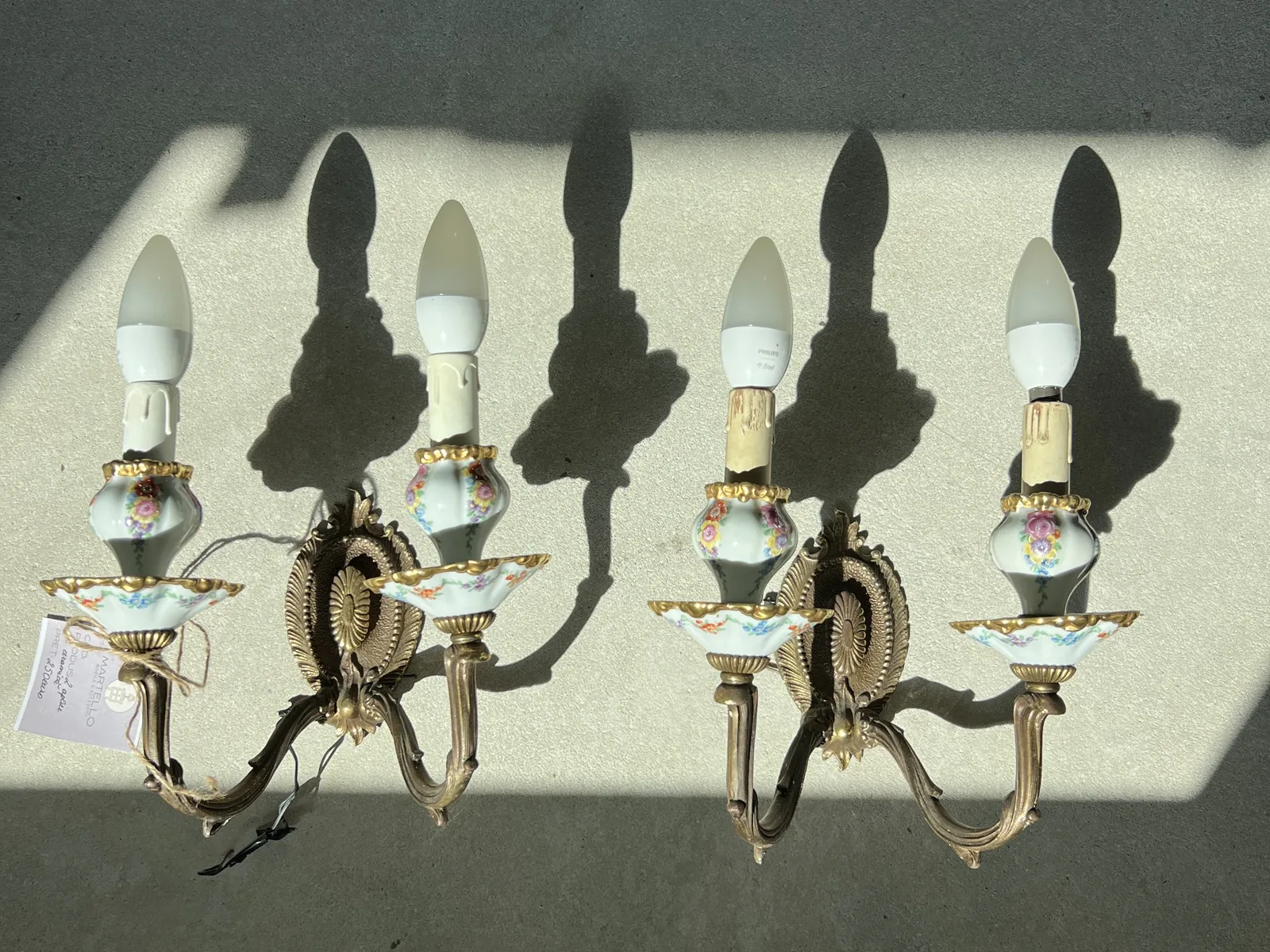
How to combine Art Deco accents with classic vintage furniture
The contrast works surprisingly well: a pair of sconces with clear geometric lines, mounted next to a carved Baroque cabinet, creates exactly the visual tension that makes a room memorable rather than monotonous. It's the same principle we explain in our guide on how to combine vintage and modern furniture with elegance — controlled contrast, not uniformity, gives a home depth.
Colours and materials suited to Art Deco accents
Polished brass or chrome, faceted glass, velvet in saturated tones (emerald, burgundy, cobalt blue), and perfect symmetry — these are the ingredients that evoke the era without requiring an actual Art Deco furniture piece. Even a single carefully chosen object can anchor the whole spirit of the style in a room.
Discover pieces with geometric accents at Martello
In the Martello catalogue, you'll find lighting, mirrors, and decorative objects with geometric lines suited to an accent that's authentic in spirit to Art Deco. You can see them at our showroom in Nimoreni, Ialoveni, fifteen minutes from Chișinău. You don't need a piece signed by Leleu to bring home a bit of 1920s geometric elegance — you just need the right eye for detail.