The Solid-Wood Bookcase: How to Choose the Right Piece and Style It With Refinement
A bookcase is never just a set of shelves for books. It is the piece of furniture that says the most about how a family lives — about what they read, about the objects gathered over the years, and about the way a room breathes. In a living room, a home office, or the hallway of a larger house, a solid-wood bookcase carries a weight and calm that furniture made from particleboard or MDF can never offer. Solid wood ages beautifully, catches the light differently at different hours of the day, and remains, year after year, a steady presence in the home.
Why Solid Wood Makes All the Difference in a Bookcase
A bookcase carries real weight — entire rows of books, porcelain objects, boxes, files. Solid-wood shelves do not sag over time the way composite materials do, and the piece's solid structure holds up for decades without losing its stability. Solid wood also has a texture and a faint, distinctive scent that nothing else reproduces — small details that matter enormously in a reading room. If you want to learn to tell genuine solid wood apart from veneer or a convincingly dressed-up composite, it's worth reading our guide on how to recognise quality solid wood as well.
Shelf Depth and the Proportions That Matter
A common mistake is choosing a bookcase that isn't deep enough. For standard-format books, the usable shelf depth should be at least 28-30 centimetres, otherwise the spines are left hanging outside the structure, fragile and exposed to knocks. For large art books or files, the depth of the lower shelves can rise to 35-40 centimetres, where heavy pieces need solid support. The height between shelves is worth thinking through differently from bottom to top: the lower shelves, taller, for large volumes; the middle ones, at eye level, for the books read most often; the top ones, for decorative pieces and objects that aren't handled daily.
Adjustable or Fixed Shelves? What to Choose and Why
Adjustable shelves, mounted on discreet metal supports or pin-and-hole systems, offer real flexibility: a book collection changes over the years, and a good bookcase needs to adapt to it, not the other way around. Fixed shelves, by contrast, give the structure a more architectural, more solid feel, suited to large bookcases built into a wall and conceived as a permanent element of the room. For the reading corner of a home, a combination of the two — a fixed carcass for visual balance, with a few adjustable shelves for flexibility — is the solution we recommend most often. You can see this idea put into practice in our article on the solid-wood reading corner for a home office.
Wood Species: Walnut, Oak, or Cherry
The choice of species completely changes the character of a bookcase. Walnut has a warm, chocolate-brown tone with a discreet, elegant grain pattern — well suited to a bookcase meant to look like a family heirloom from the very first day. Oak, lighter and more textured, brings a robust feel, well suited to large, many-shelved bookcases in a masculine study or a country-house library. Cherry darkens beautifully over time, taking on increasingly deep reddish tones as it's exposed to light — a species for those who appreciate pieces that transform year by year. If you're still torn between the three, our detailed comparison of walnut, oak, and cherry explains exactly which species suits each interior style.
Glass Doors, Solid Doors, or Open Shelving
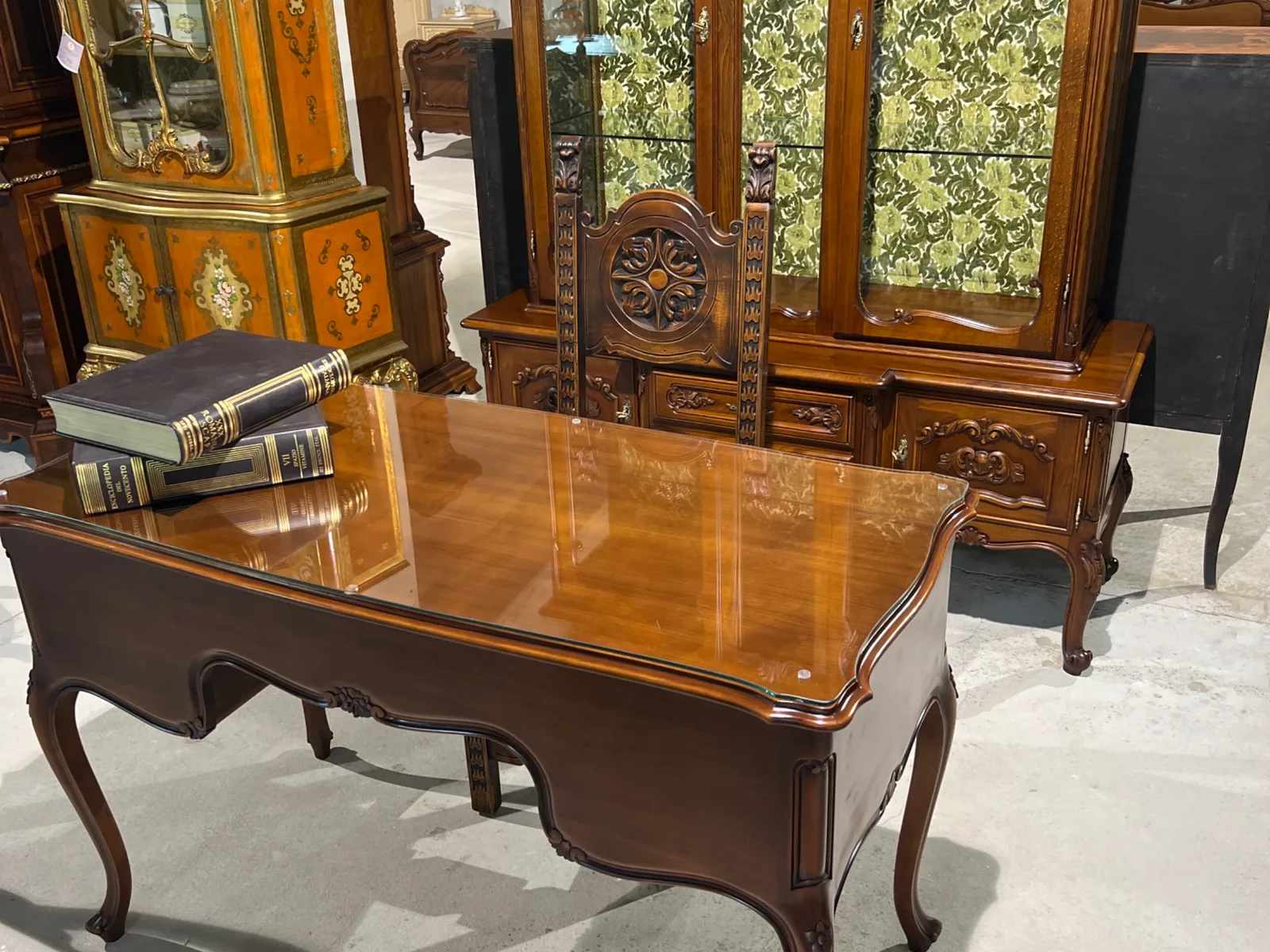
Fully open shelving showcases book spines and turns the bookcase into an active decorative element, but it demands discipline in arranging and constant dusting. Glass doors — classic, framed in solid wood, with plain or bowed glass — protect old and precious books from dust and direct light while keeping the collection visible. Solid doors, usually reserved for the lower shelves, elegantly conceal files, boxes, or less decorative objects, leaving the upper part of the bookcase free for display. The most successful bookcase, as a rule, combines all three solutions on the same piece of furniture.
The 60/30/10 Rule and the Art of Styling Shelves
A bookcase packed with books from end to end tires the eye. The 60/30/10 rule, borrowed from interior design, works very well here too: roughly 60% of the space taken up by books, 30% by decorative objects (small vases, photo frames, crafted boxes), and 10% left empty, as visual breathing room. Books can be grouped vertically, in blocks of colour or height, occasionally interrupted by horizontal stacks topped with a small object — a marble sphere, a figurine, a clock. That intentional gap, left on every third shelf or so, is what turns a cluttered bookcase into a carefully considered one.
The Right Light and Fitting the Bookcase Into the Room
Direct natural light, falling on book spines for hours on end, fades them and dries out their bindings — which is why a well-thought-out bookcase avoids a wall fully exposed to the afternoon sun. A reading lamp placed nearby, or discreet ambient lighting built into the shelves, completely changes the mood of the evening; you'll find concrete ideas in our guide to refined ambient lighting. In a home office, a bookcase works best against a side wall, not behind the desk as a backdrop for video calls — a solution we cover in detail in our guide to furnishing a refined home office.
A Unique Piece for Your Reading Corner
At Martello Mobili, we select solid-wood bookcases precisely for these qualities — correct proportions, genuine wood species, hardware suited to the piece's age. Every bookcase in our collection is a one-of-a-kind piece: once sold, it is never repeated. You can see them in our showroom in Nimoreni, Ialoveni, just 15 minutes from Chișinău, alongside the rest of the Martello collection's home office furniture. For more solid-wood pieces selected with the same care, explore the Martello catalogue and find the piece that will become, years from now, your home's family bookcase.