The Renaissance Dining Set: A Table Fit for a Manor
There are tables you simply sit at, and tables around which a whole household gathers. The Renaissance dining set belongs firmly to the second kind. It is not merely a surface for plates but a piece that gives a room its gravity, a sort of spine for the home around which holidays, long conversations and comfortable silences collect. At Martello we select pieces like these for people who want their dining room to breathe the air of a manor house rather than a showroom.
Where the Renaissance style comes from
The Renaissance was a cultural rebirth that looked back to antiquity, between the late 1400s and the early 1600s, when Florence, Venice and Rome became artistic centres through global trade and a humanist belief that art sat at the centre of life. The furniture of that age inherited a strong architectural sense: columns, pediments, cornices and pilasters, as if every piece were a small palace. Cabinets echoed the fronts of basilicas, and table legs took the shape of turned columns or carved pedestals. The table was not merely useful, it was a status symbol, a mirror of its owner's standing.
The wood that changed everything
The great Renaissance revolution in furniture was the shift from oak to walnut. Walnut has a finer grain, tighter pores and a richer surface, far better suited to detailed carving and to polishing. Over time it develops a warm patina that no hurried process can imitate. This is precisely why an authentic Renaissance table looks alive: light slides differently across the carved volumes, and the colour deepens with every passing decade. To understand why the species of wood matters so much, it is worth reading our guide on how to choose between walnut, oak and cherry.
What a complete set includes
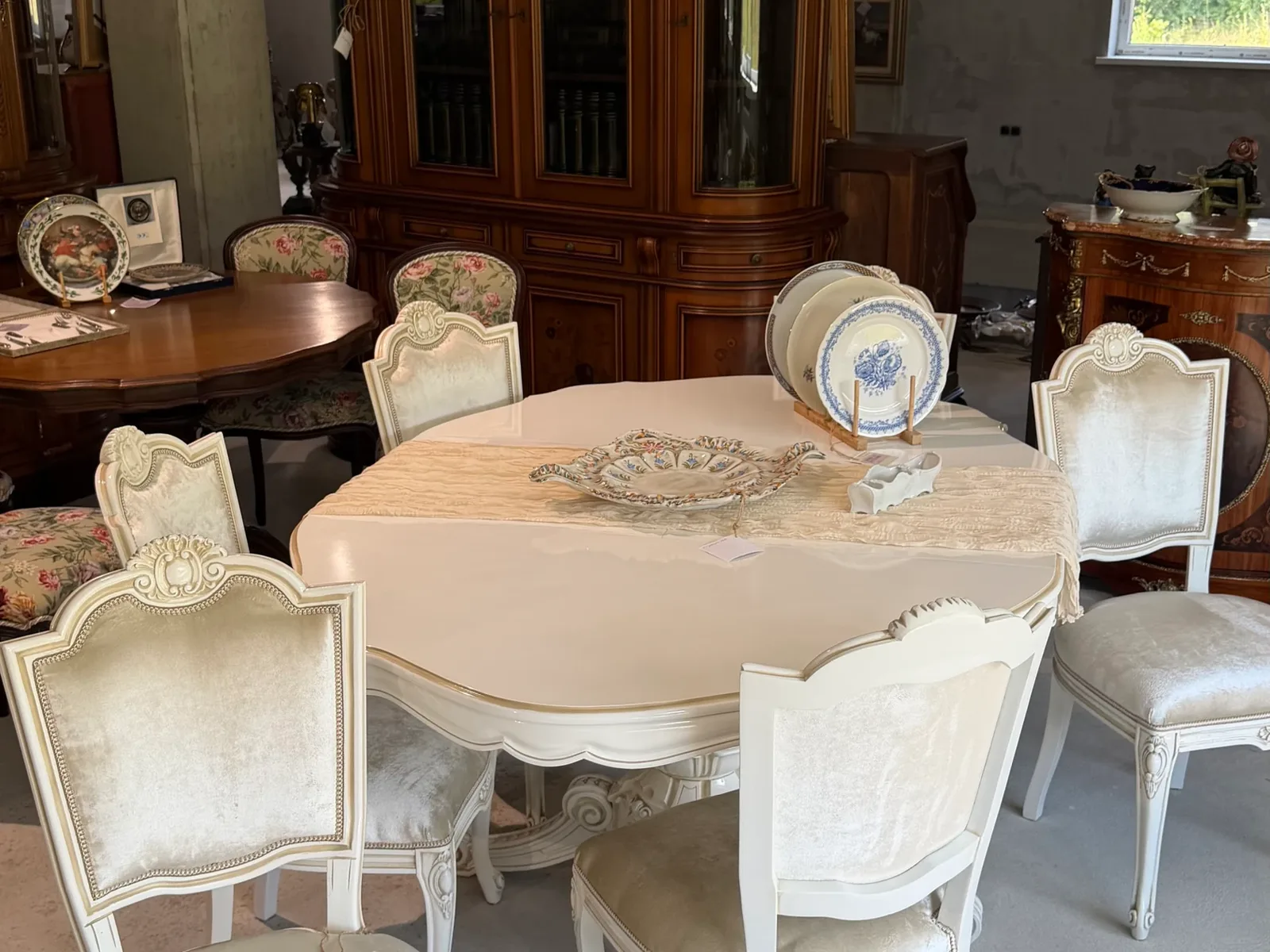
A properly conceived Renaissance dining set is not just a table with a few chairs gathered at random. It usually comprises a substantial table with carved legs or a central pedestal, a row of high-backed chairs upholstered in velvet, leather or tapestry, often a display cabinet or sideboard to hold the silver and porcelain, and sometimes an accent piece such as a console or a heavily framed mirror. The beauty of a set is that the pieces were made to converse: the same carved motifs, the same tone of wood, the same grace of proportion. You can see the logic of a unified ensemble in our article on arranging a dining room in the classic style.
Why it is worth buying as one set
The temptation to gather pieces one by one, here and there, is strong, but it rarely produces a coherent result. A set bought as a whole guarantees that the table and chairs share the same age, the same carver's hand and the same shade of finish, things almost impossible to match afterward. At Martello we work with one-of-a-kind pieces: once a set is sold, it is never repeated. This is not mass-produced furniture ordered in ten identical copies, but a rarity with its own biography. That is exactly why a complete dining room remains an investment that holds its value over time, unlike furniture that dates within a single season.
How to keep it alive rather than museum-like
People's greatest fear is that a Renaissance table will turn the home into a frozen stage set. The secret, designers say for 2026, is the curated vintage approach: you do not want to live in a museum, you want to punctuate a contemporary interior with two or three strong pieces that have already lived a life. Set the substantial table on a modern rug with a simple texture. Place a relaxed floral arrangement on top rather than a ceremonial one. Pair the carved chairs with minimalist tableware and understated textiles. It is precisely the contrast between the gravity of the wood and the lightness around it that lets the piece breathe. We explore the idea of blending eras with elegance at length in our guide on how to combine vintage and modern furniture.
The shape of the table and the light above it
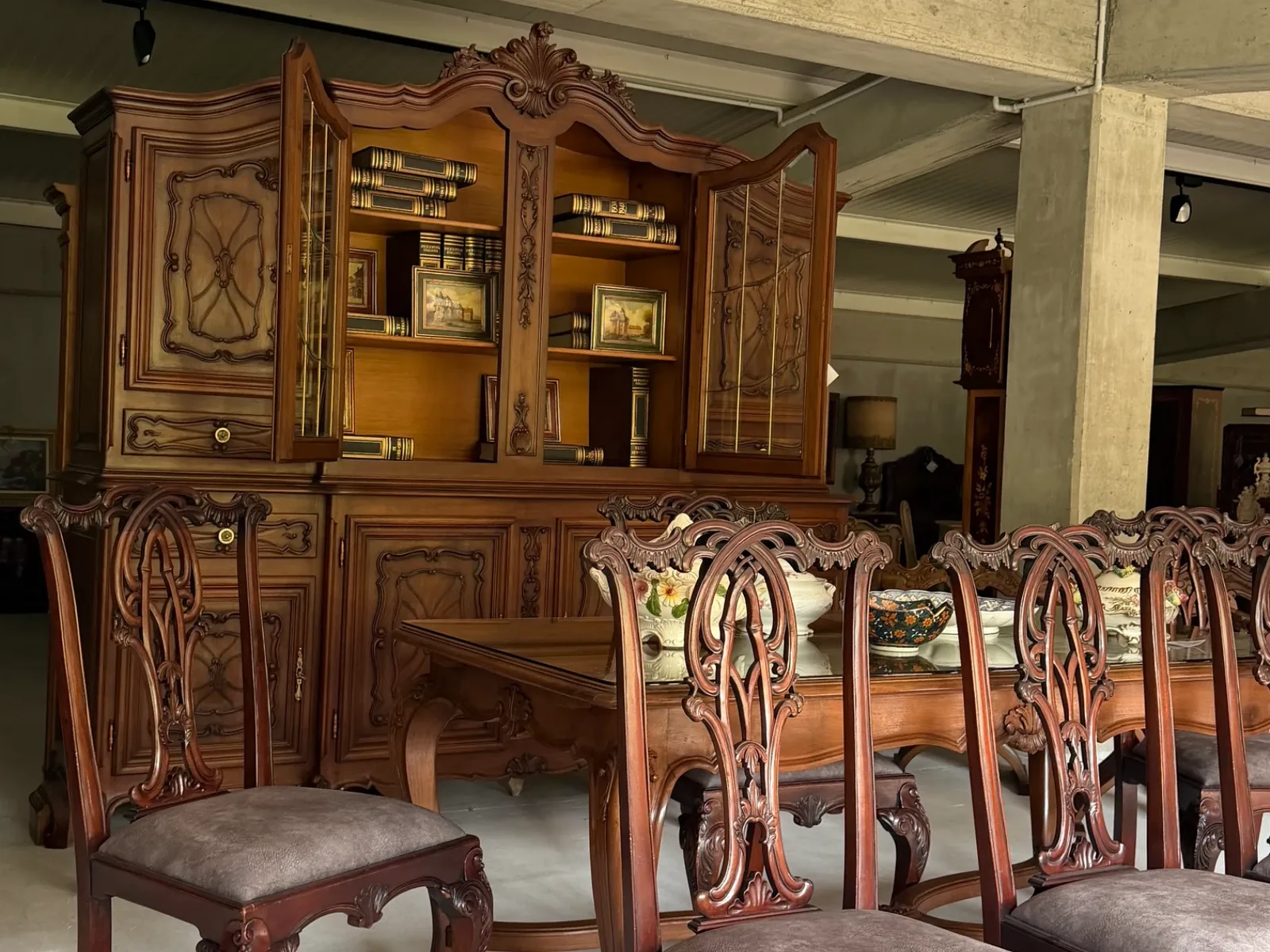
Dining rooms are returning in force in 2026, with warmer colours, more tactile materials and tables treated once again as the centrepiece of the home. Shape matters: a long rectangular table evokes the atmosphere of a manor and seats guests ceremoniously, while an oval or round form draws people closer and encourages conversation. If you are hesitating, our comparison of an oval versus round table will help. Above it, a generous chandelier completes the scene; warm, layered light brings out the carved volumes exactly as candlelight brought them out in the period.
The care that preserves the patina
A solid walnut table asks for little, but regularly. Wipe it with a soft, dry or barely damp cloth, keep it away from radiators and direct sun that dries the wood, and feed it from time to time with a natural wax that strengthens the patina rather than covering it. Avoid abrasive products and standing moisture. You will find the practical details in our guide on caring for solid wood tables, and for the festive table our article on the perfect table for celebrations will serve you well.
Where to see it in person
A Renaissance set is not chosen from a photograph. You need to run your hand over the carving, feel the weight of a chair, see how it catches the light. We look forward to welcoming you at the Martello showroom in Nimoreni, Ialoveni, just 15 minutes from Chișinău, from where we deliver across Moldova and Romania. Explore the whole collection in our catalogue or look directly at the pieces in the dining room category. Every set you find there is a one-of-a-kind piece, with its own history and a single chance to become its owner.